


The Afsluitdijk is the iconic symbol of Dutch hydraulic engineering. Since 2019, the dike has been undergoing large-scale reinforcement to withstand superstorms and increasing water discharge. De Gilde Groep also contributed to this operation, notably through concrete technologist and quality officer Aad Leering.
After seven years of intensive work, the project is gradually coming to completion. The dike was reinforced with 75,000 unique Levvel blocks and expanded with new sluices and a pumping station at Den Oever. Aad played an important role in these components, thanks to his extensive knowledge of concrete.
Better every day
Aad worked for fifteen years at what was at the time the largest concrete plant in Western Europe. There, he designed concrete mixes daily and personally monitored their quality. “The next day, I could immediately see the results because I took the samples myself and carried out the tests. That’s how I improved every day.”
Six years ago, he joined De Gilde Groep at Levvel, where he worked on producing the XblocPlus blocks specially designed for the Afsluitdijk. For the production of the 75,000 blocks, a new factory was built, which initially experienced some start-up challenges.
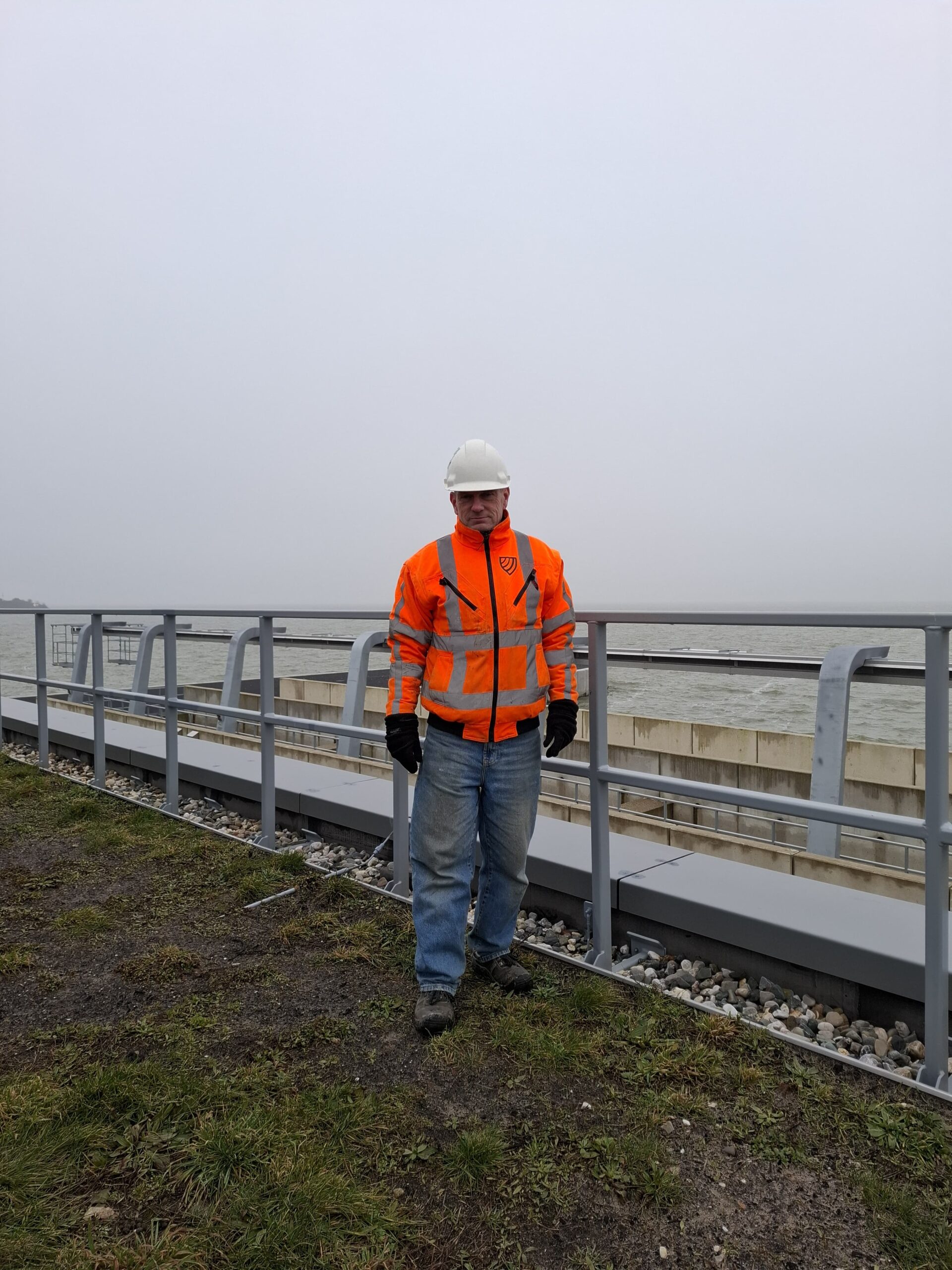
That’s how I improved every day
The process was fully automated: trolleys with molds on rails were filled with concrete, stripped, and moved via a mechanical gripper. This gripper applied pressure to the fresh concrete. Each block had to reach a minimum compressive strength of 10 N/mm² at the time of stripping. “And I had to guarantee that,” Aad explains.
Self-developed calculation method
Due to frequent system malfunctions and tight deadlines, Aad developed his own method to predict the stripping moment with an accuracy of one-tenth of an hour. “By continuously measuring, comparing, and adjusting, I could increasingly accurately determine when a block was strong enough. Of the 75,000 blocks, only two ever fell from the gripper. That’s exceptionally few.”
In the end, the deadline was met thanks to clever tricks and Leering’s presence. “Certain tricks made the concrete mix very sensitive, and the slightest deviation could mean discarding the concrete or chipping out the mixer. That’s why I had to constantly monitor the process and direct the mix masters carefully. I was always adjusting controls to optimize the process.”
A challenge on the Afsluitdijk
After this job, Aad was looking for a new challenge, which he found on the Afsluitdijk itself. “In the first few months, I still had a lot to learn. I had never seen reinforcement drawings before.” By now, he has mastered everything and feels completely at home.
His responsibilities are broad: he contributed to the construction of the new pumps, sluices, and the associated underground concrete structures at Den Oever. “The glass domes (see photo) are the pumps. Below them, we created a 17-meter-deep basin. Under the road, large waterways were constructed through which the pumps discharge water. Beneath it all is an enormous underground structure made of tens of thousands of cubic meters of concrete.”
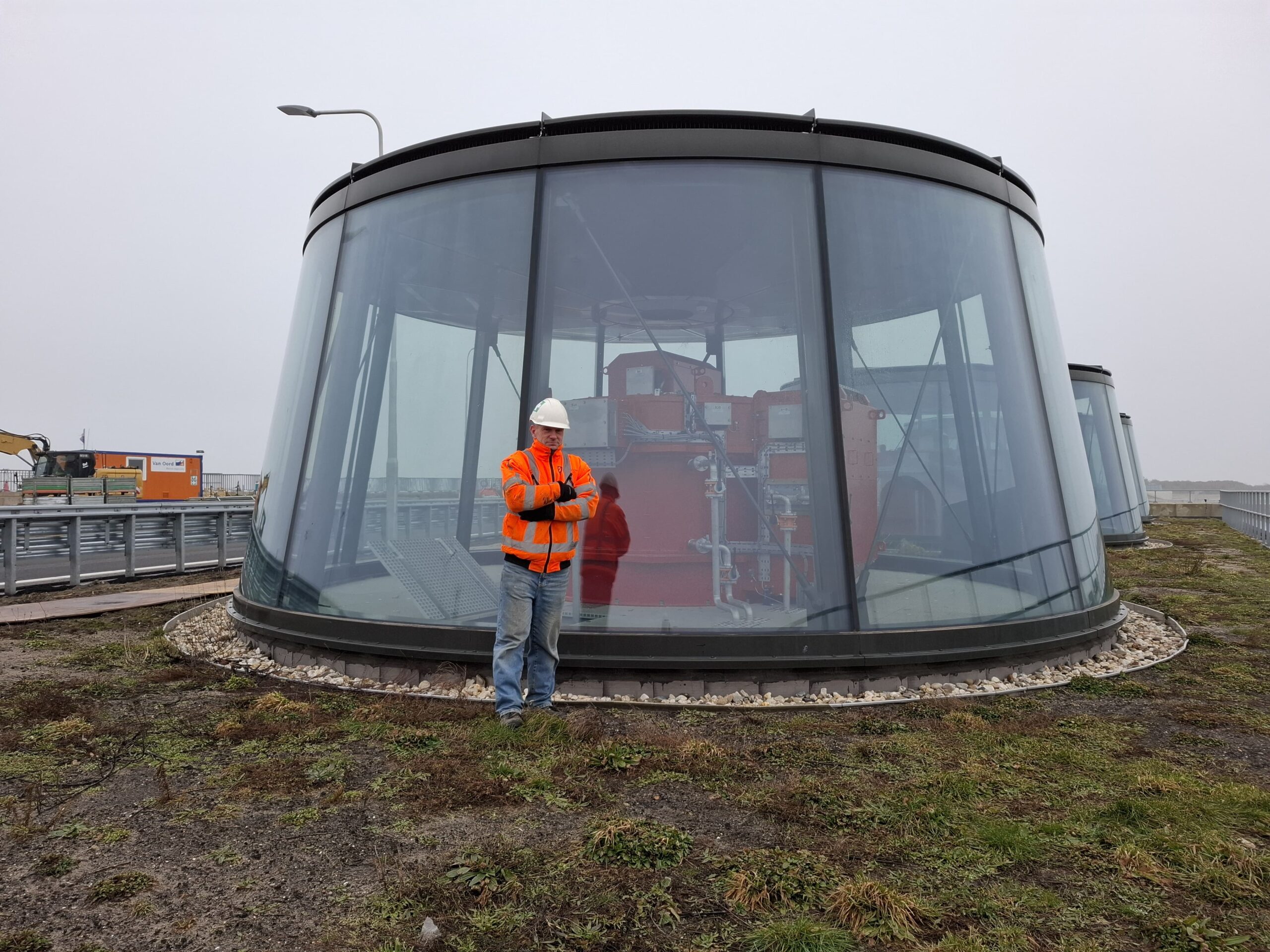
Beneath is an enormous underground structure made of tens of thousands of cubic meters of concrete
He was also involved as a quality officer in the construction of the sluice groups — large passages under the road through which water is discharged. “There were two groups, each with large passages under the road. For a section like this, you first cordon off part of the road and remove the pavement, install sheet piles, excavate, and pour underwater concrete for the floor. Then come the walls, the roof, and the road is restored. You can imagine that both projects involve an enormous amount of work.”
Rijkswaterstaat cites the method as an example
Aad ensures quality: “I check that everything is executed according to specifications. For reinforcement, for example, I verify that all bars are installed according to the drawings. I inspected all the reinforcement for those basins myself, that takes some time,” he says with a laugh.
Am I proud of that? Not really. It’s just work
It is time-consuming work, but successful. “Our method of coverage measurements is cited by Rijkswaterstaat as an example for other projects.” A nice compliment for everyone involved, including Aad, though he immediately downplays it. “Am I proud of that? Not really. It’s just work.”
As masters of craftsmanship, quality is a basic requirement for us as an organization. Aad delivers that quality daily on the Afsluitdijk, and in turn, he also benefits from it. “The great thing about working for De Gilde Groep is that you worry less. As a freelancer, you have to do everything yourself and follow up on everything,” he explains. “At De Gilde Groep, that’s taken care of for me. I can focus on what I enjoy and what I’m good at. That makes working here really pleasant.”
With the completion of the work on the Afsluitdijk in sight, the Netherlands is once again better protected against water. And we are proud to have contributed to this remarkable project and the safe future of the country.